
Years ago, when my children were still little and I started making my own Chanukah parties at home, presents were part and parcel of the party. Half the fun for me was figuring out what each child wanted without giving away the surprise. I’d fish for information, keep an eye on my budget, and try to find something they’d still be playing with in June. I took this job quite seriously, considering nobody had hired me.
One Chanukah, I spent hours in the toy store choosing a gift for my son. He was six, maybe seven. He loved to build, and by then he was into the tiny LEGO pieces. So far, so good. Except that the toy store had rather more than one box of tiny LEGO pieces. I picked up a box. Put it back. Read the back of another box as though somewhere in the fine print it might say, “Yes, this is the one your son wants.” Eventually I settled on a set with a police station, a fire station, and who remembers what else. Whatever emergency those little LEGO people might have, I had seen to it that help was available.
At home I wrapped all three children’s presents beautifully. Come the party, they started tearing into the paper, and I watched my son. I’d been looking forward to that face all day. I saw his smile disappear. Then came a cry so piercing you’d think we could’ve used some of the emergency personnel in the box.
He bawled. He’d been expecting something else, and at six or seven he hadn’t yet mastered the art of saying, “How did you know?” while quietly feeling around for a gift receipt. And honestly, my heart hurt. I’d spent hours in that aisle picturing how happy he’d be. Now he was crying, and all I wanted was another crack at making him happy.
The next day I took him back and let him choose. He picked a remote-control car. I think it lasted two days. He was delighted with his choice, which, you may recall, had been the whole idea.
The following Chanukah I introduced a new family minhag. “Kinderlach, what do you want for Chanukah?” They each told me. I went shopping by myself. Everybody was happy. I wondered why it had taken me a police station and a fire station to arrive at this arrangement.
It worked beautifully until the children got a little older. It turns out “I want a watch” is only the beginning of a conversation. There is the watch your child has in mind, and there is the watch you come home with, and both of them, unfortunately, tell time.
Meanwhile, my mother and my mother-in-law each had a Chanukah party to make. They’d generously offer me a budget and a credit card so I could choose something my children would love. By then I was shopping for my own party and both grandmothers’ parties, and before I ordered anything I had calls to make. What was my sister-in-law getting for her child the same age? Because my daughter could love her gift right up until her cousin opened hers. Then there we’d be, negotiating a peace agreement over a craft kit.
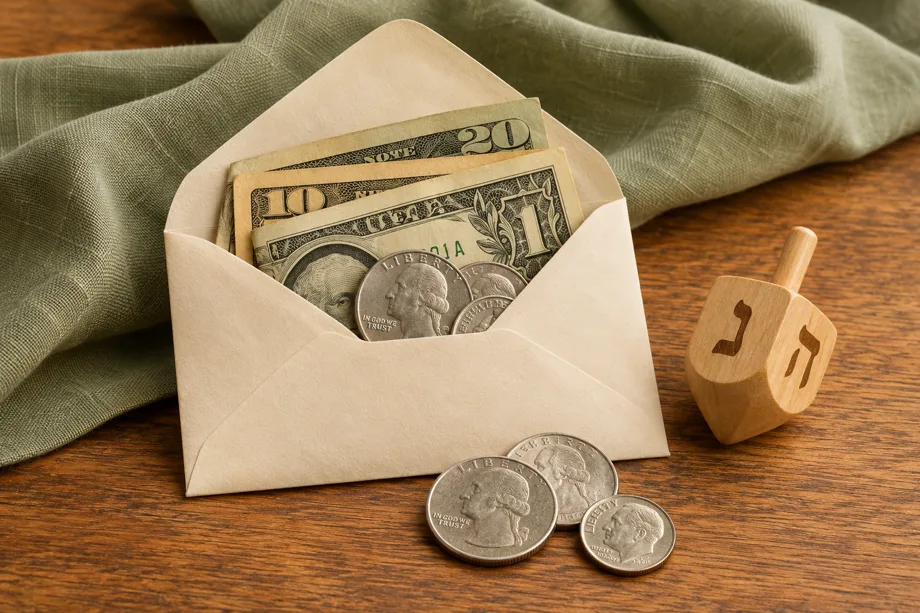
One year, when my mother-in-law asked us to pick out the presents, my sisters-in-law and I got to talking. Whatever happened to Chanukah gelt? For the older kids, why couldn’t we just give money? My mother-in-law settled on an amount for each age group. Cousins in the same bracket got the same amount. The envelopes went around. The kids were happy. And somewhere, a toy-store employee got to go home on time.
We light the menorah, we eat latkes, and we give the children Chanukah gelt. Each has its place in our Chanukah, and giving gelt is a minhag we have kept for generations. I can give my children a present any time. The idea that a holiday calls for a pile of wrapped gifts belongs to the secular holiday season. What I find beautiful is that when my mother-in-law hands out the gelt, the kids get to feel the Yom Tov through our own mesorah. Those little envelopes belong to Chanukah every bit as much as the latkes on the table.
There’s a practical bonus, too. If I buy my daughter a watch, what she takes home is a watch. Give her gelt and she can put some aside for tzedakah, count what’s left, and work out what she can do with it. “If I buy these two little things, will I still have enough for the watch I really want?” Maybe she buys the two little things. Maybe she puts the money in the bank and waits until she’s saved enough for that watch. Either way, she’s worked out a budget with her own money. Funny how a child who wanted something right this minute can suddenly see the merits of waiting when she’s the one paying.
I’d still wrap a little tchotchke for the youngest ones. A fancy pen and enough ribbon to keep small fingers busy can make a very fine present. For the older kids, give me the envelopes. The cousins know what to expect, the kids go home happy with a decision that belongs to them, and I can go straight home, too. No standing in the toy store racking my brain. No watching a little face fall when the paper comes off.
And if my son spends his gelt on a remote-control car that lasts two days? I hope he enjoys both days. At least nobody has to cry over a perfectly good police station.
Comments
Loading comments…